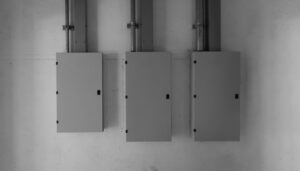
Choosing an electrical enclosure involves more than finding a box that fits the components. The enclosure must suit the equipment, installation method, and operating environment while providing sufficient room for controls, connectors, wiring, ventilation, and maintenance.
The main types of electrical enclosures include hand-held cases, desktop instrument cases, panel-mounted enclosures, wall-mounted boxes, 19-inch rack cases, power supply cases, potting shells and screened enclosures. Each format serves a different purpose, and the right choice depends on how and where the finished equipment will be used.
This guide explains the main electrical enclosure types, available materials and practical factors to consider before selecting a standard product or requesting a custom design.
What Is an Electrical Enclosure?
An electrical enclosure is a housing that surrounds electrical or electronic components. It can provide physical protection, prevent unauthorised access, and provide a suitable mounting structure for internal parts, controls, and displays.
Depending on its design, an enclosure may also protect equipment against dust, water, impact or electromagnetic interference. These properties are not automatically provided by every box. They depend on the material, construction, seals, joints, openings and complete assembled design.
What Are the Main Types of Electrical Enclosures?
Electrical enclosures can be classified by their physical format, mounting method, material and intended level of protection.
| Enclosure type | Typical application | Main consideration |
| Hand-held enclosure | Portable controllers and test equipment | Weight, grip and component access |
| Instrument case | Desktop and bench equipment | Controls, displays and viewing angle |
| Panel-mounted case | Instrumentation and control panels | Cut-out and mounting dimensions |
| Wall-mounted enclosure | Fixed control and electrical equipment | Environment and ingress protection |
| 19-inch rack case | Communications and test systems | Rack dimensions and ventilation |
| Power supply case | Power conversion equipment | Heat and electrical access |
| Potting shell | Encapsulated components | Resin, cable exits and servicing |
| Screened enclosure | EMI-sensitive equipment | Grounding, joints and openings |
| Custom enclosure | Specialist electrical equipment | Design, quantity and manufacture |
Hand-Held Enclosures
Hand-held enclosures are intended for portable equipment such as controllers, monitoring devices, test instruments and data-collection equipment.
A suitable design needs to feel secure and comfortable in use while providing sufficient internal space for the PCB, batteries, controls, and connectors. Key considerations include:
- Overall size and weight
- Grip and surface shape
- Battery access
- Display and keypad position
- Internal PCB mounting
- Cable and connector access
- Impact during use or transport
Lightweight moulded materials, such as ABS, are often used for portable equipment. We supply a range of ABS hand-held cases for electronic and electrical applications.
Desktop and Instrument Cases
Desktop and instrument cases are commonly used for test equipment, measuring instruments, control systems and laboratory electronics. They may sit on a workbench, a desk, or another horizontal surface.
The enclosure should provide a stable base and allow users to see and operate controls without difficulty. Component height, front and rear panel space, ventilation and maintenance access must all be considered.
A flat case may suit equipment with controls on the top or front. A sloping-front instrument case can provide a more practical viewing and operating angle for displays, buttons and switches.
Our wider range of moulded boxes and instrument cases includes options to meet various electronic and electrical packaging requirements.
Panel-Mounted Instrument Cases
Panel-mounted cases are installed into a control panel, console or equipment face. They are often used for meters, displays, timers, monitoring equipment and control instruments.
Choosing a panel-mounted case requires accurate measurements. The front bezel may cover the panel opening, but the main body must fit through the specified cut-out. Space must also be allowed behind the panel for terminals, connectors, cables and maintenance.
The panel cut-out, front bezel, enclosure depth and rear clearance should be reviewed together. The fixing method must hold the enclosure securely without placing excessive stress on the case or surrounding panel.
Wall-Mounted Enclosures
Wall-mounted electrical enclosures are used when controls, wiring, or electronic equipment need to be mounted to a vertical surface. Applications range from indoor control systems to equipment installed in exposed industrial environments.
The operating location is particularly important. An indoor enclosure in a clean, controlled environment may have different requirements from one exposed to dust, moisture, chemicals or changing temperatures.
The designer should consider the door or lid arrangement, cable-entry positions, wall fixings and required ingress protection. The choice between plastic and metal should be based on the application’s conditions, not appearance alone.
Any holes added for cables, controls or ventilation must be considered as part of the complete enclosure design.
19-Inch Rack Cases and Cabinets
A 19-inch rack enclosure is designed to house equipment within a standard rack format. These enclosures are widely used for communications, audio, laboratory, test and industrial control equipment.
Rack height is commonly described in rack units, while depth depends on the equipment and cabinet. The design must allow room for internal components, rear connections and cables.
Equipment weight, front and rear access, ventilation, removable panels and cable management should be established before choosing a case. Heavy or heat-generating equipment may also need additional support and a planned cooling arrangement.
Power Supply Cases
Power supply cases house power conversion components and related electrical assemblies. Their design must account for component size, heat generation, cable entry and access to electrical parts.
Transformers, heat sinks, fuses, switches and connectors can all affect the required dimensions. Internal barriers or strain relief may also be necessary, depending on the design.
Ventilation may be required, but openings should be planned carefully. Their size and position can affect airflow, contact protection, ingress resistance and electromagnetic performance.
We offer power supply cases for relevant equipment and packaging applications.
Potting and Encapsulation Shells
Potting shells house electrical or electronic components that are encapsulated in a protective compound. Encapsulation can help secure components and protect them from movement, moisture or contamination, depending on the materials and process used.
Once the compound has cured, access to the enclosed parts may be limited or impossible. The circuit design, connections and component placement should therefore be checked before potting begins.
The shell must provide enough internal room for the components and cable exits. Compatibility between the shell and potting compound, heat produced during curing and the operating temperature of the finished assembly should also be reviewed.
We supply potting and encapsulation shells in different formats.#
RFI and EMI Screening Enclosures
Electrical and electronic equipment can generate electromagnetic energy or be affected by interference from nearby sources. Where this presents a problem, an RFI or EMI screening enclosure may form part of the control strategy.
Metal enclosures provide a conductive structure, while plastic cases may require an appropriate screening treatment. Performance depends on more than the base material. Seams, joints, openings, grounding, ventilation and cable entry all influence the completed design.
Screening may be considered where equipment contains sensitive receivers or measurement circuits, uses high-frequency switching components or operates close to other electronic systems. Testing and investigation should establish the likely source and path of interference before a particular solution is selected.
We provide RFI screening for plastic cases alongside metal screening solutions.
Custom Electrical Enclosures
An off-the-shelf enclosure may not suit equipment with unusual dimensions, restricted installation space or specific access requirements.
Custom manufacture may be appropriate when the application requires:
- A particular enclosure size
- Custom front or rear panels
- Multiple connector openings
- Unusual mounting features
- A specialist material or finish
- Ventilation in defined positions
- RFI or EMI screening
- Repeat manufacture to an agreed design
A custom enclosure still needs to be assessed as part of the complete equipment. Dimensions, materials, tolerances, assembly sequence and production quantities should be agreed before manufacture.
Our custom design service supports electrical and electronic packaging applications that cannot be met by a standard case alone.
Which Electrical Enclosure Material Should You Choose?
The enclosure material should be selected based on the operating environment, mechanical demands, weight, thermal requirements, electromagnetic performance, and manufacturing method.
| Material | Common characteristics | Matters to assess |
| ABS | Lightweight, insulating and suitable for many indoor applications | Heat, impact, UV exposure and screening |
| Polycarbonate | Strong, lightweight and electrically insulating | Chemicals, cost and surface treatment |
| GRP | Electrically insulating and corrosion-resistant | Finish, machining and dimensions |
| Aluminium | Lightweight, conductive and corrosion-resistant | Joints, finish and grounding |
| Steel | Strong and suitable for fabricated enclosures | Weight and corrosion protection |
| Stainless steel | Durable and resistant to corrosion | Cost, weight and fabrication |
| Diecast metal | Strong and suitable for compact housings | Machining, openings and quantities |
Material names alone do not confirm suitability. The grade, thickness, construction, finish and full operating conditions also matter.
When is a plastic enclosure appropriate?
Plastic enclosures can offer low weight, electrical insulation, and corrosion resistance. Moulded shapes can also provide integrated features such as PCB guides, screw bosses, battery compartments and contoured hand-held forms.
Plastic may suit portable instruments, indoor equipment and applications where a conductive housing is not required. The designer should still assess operating temperature, UV exposure, impact, chemicals, cleaning products and electromagnetic requirements.
Different plastics have different properties, so ABS, polycarbonate and GRP should not be treated as interchangeable.
When is a metal enclosure appropriate?
Metal enclosures are often used when the application requires strength, fabrication flexibility, heat transfer, or a conductive housing.
Aluminium can reduce weight while providing a conductive structure. Steel offers strength and can be formed into larger cases and cabinets. Stainless steel may suit applications where corrosion resistance and repeated cleaning are important.
Metal construction does not automatically provide complete electromagnetic screening. Joints, lids, apertures and grounding arrangements must still be designed correctly.
What Do IP Ratings Mean for Electrical Enclosures?
An IP rating describes the level of protection provided by an enclosure against access to hazardous parts, solid objects, and water.
The first numeral relates to access and solid-object protection. The second relates to water. An X may be used where one part of the rating has not been specified.
The required rating should be based on the actual environment rather than selecting the highest available number. A sealed outdoor enclosure may need different protection from a ventilated instrument case used in a dry laboratory.
It is also important to consider the finished assembly. Cable glands, connectors, ventilation holes, controls and other modifications can affect its protection. A base enclosure rating should not automatically be assumed to apply after unassessed alterations.
How Do You Choose the Right Electrical Enclosure?
The right enclosure must fit the equipment and support its intended use. Working through the following considerations can help prevent problems during assembly, testing and installation.
Define what the enclosure will contain
Start by recording the dimensions and positions of the printed circuit boards, power supplies, displays, controls, batteries, wiring, terminals and connectors.
Include the space required for fixings, cable bends, and assembly tools, rather than measuring only the main components. Heat sinks, mounting plates and internal barriers can also reduce the usable space.
Measure the available installation space
Record the maximum external length, width and height. Then check whether the selected enclosure provides enough usable internal room.
Internal dimensions can be affected by wall thickness, ribs, screw bosses, lid construction and mounting features. Space may also be needed outside the case for cables, connectors, hinges or a removable lid.
Identify how the equipment will be used
Consider whether the finished product will be held, carried between locations, operated on a desktop, installed into a panel, fixed to a wall or mounted in a rack.
The way users interact with the equipment affects its shape, control position, weight and access requirements. A design that works well on a bench may be unsuitable for portable or wall-mounted use.
Assess the operating environment
Consider every condition the enclosure may encounter during transport, storage and operation. Dust, water, chemicals, temperature changes, impact, vibration, UV exposure and cleaning processes can all influence the specification.
Protection should be based on the conditions at the final installation location, not only the environment in which the product is assembled.
Consider heat and ventilation
Power supplies, processors and other components can generate heat. The enclosure should allow this heat to be managed so that internal temperatures do not exceed the equipment’s operating limits.
Possible approaches may include natural airflow, ventilation openings, conduction through the enclosure or a separate cooling system. Ventilation should not be added without considering its effect on dust, water, contact protection and electromagnetic screening.
Determine whether RFI or EMI control is required
Review whether the equipment generates electromagnetic emissions or contains circuits that may be affected by interference.
The enclosure may form one part of the solution alongside PCB layout, grounding, filtering, cable screening and component placement. The source and path of the interference should be investigated before selecting a screening method.
Plan controls, connectors and access
Mark the position of displays, switches, buttons, terminals, cable glands and connectors. Consider how the user will operate the equipment and how technicians will inspect or repair it.
A removable panel or lid may be necessary where parts require testing, adjustment or replacement. Connector depth and cable movement should also be included in the layout.
Check mounting and assembly requirements
Establish how internal components will be secured and how the enclosure will be assembled. PCB guides, mounting plates, brackets, spacers, threaded inserts and external fixing points may all need to be incorporated.
The order in which the parts are installed can be as important as their final dimensions. A component that fits inside the completed case may still be difficult to position during assembly.
Choose between a standard and custom enclosure
A standard enclosure may be a good option when its dimensions, materials, and access arrangements meet the application.
Customisation may be appropriate where the project requires machining, printed panels, specialist finishes, non-standard dimensions, unusual mounting features or a defined screening arrangement.
Confirm prototype and production quantities
State whether the requirement is for a single prototype, a small batch or repeat production.
Quantities can affect the most suitable material, manufacturing process and level of customisation. Sharing expected future volumes helps the manufacturer assess the complete requirement rather than only the first order.
Standard or Custom Electrical Enclosure: Which Is Right for You?
| Choose a standard enclosure when: | Consider a custom enclosure when: |
| Available dimensions suit the equipment | The installation space is restricted |
| Standard access arrangements are suitable | A specific access arrangement is required |
| Only minor modifications are needed | Multiple custom openings are required |
| The material suits the environment | Specialist materials or finishes are needed |
| The mounting method fits the application | Internal mounting must follow the equipment |
| Existing protection is appropriate | Screening or unusual protection is required |
Starting with a standard enclosure is sensible when it satisfies the technical requirements. Customisation becomes more appropriate when altering an existing case would compromise fit, assembly, access or performance.
Discuss Your Electrical Enclosure Requirements With Perancea
We supply standard and custom enclosure solutions for electrical, electronic and instrumentation applications. Its capabilities include moulded boxes, instrument cases, RFI and EMI screening, custom design and fine-tolerance sheet metalwork.
To discuss an application, provide the team with your equipment dimensions, drawings, required quantities, installation method and any environmental, thermal or screening requirements.
Contact us to discuss a suitable standard enclosure or a custom design for your equipment.